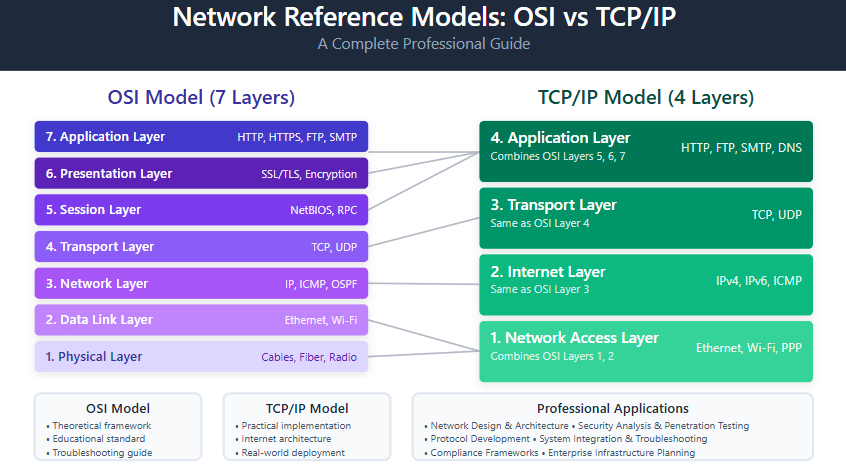
Have you ever wondered how your computer communicates with servers around the world in milliseconds? The magic lies in network reference models – theoretical frameworks that organize and standardize how devices communicate across networks. Today, we’ll explore the two most important models that power our connected world: the OSI Model and the TCP/IP Model.
What Are Network Reference Models?
Think of network reference models as architectural blueprints for digital communication. Just as architects use standardized plans to build skyscrapers, network engineers use these models to design and troubleshoot communication systems. They provide a common language that helps professionals understand how data travels from your device to its destination.
The OSI Model: A Seven-Layer Approach
Developed by the International Organization for Standardization (ISO) in the 1980s, the OSI (Open Systems Interconnection) Model divides network communication into seven distinct layers. Let’s explore each layer from top to bottom:
Layer 7: Application Layer
This is where you interact directly with applications. When you open your web browser or send an email, you’re working at this layer. It provides network services that applications need to function.
Real-world example: Opening Chrome or Firefox to browse the web.
Layer 6: Presentation Layer
This layer handles data formatting, encryption, and compression. It ensures that data sent from one system can be understood by another, regardless of their internal formats.
Real-world example: Compressing a ZIP file before sending it via email.
Layer 5: Session Layer
The session layer manages conversations between devices. It establishes, maintains, and terminates connections, ensuring organized communication.
Real-world example: Starting an online video call and maintaining the connection throughout your conversation.
Layer 4: Transport Layer
This layer ensures reliable data delivery. It handles segmentation, flow control, and error recovery, making sure your data arrives complete and in order.
Real-world example: TCP (Transmission Control Protocol) ensures all parts of a downloaded file arrive correctly.
Layer 3: Network Layer
The network layer handles routing and addressing. It determines the best path for data to travel across multiple networks and assigns logical addresses to devices.
Real-world example: IP (Internet Protocol) routing your web request from your home network to Google’s servers.
Layer 2: Data Link Layer
This layer manages communication within the same local network. It organizes data into frames and handles error detection and correction at the local level.
Real-world example: Ethernet protocols manage communication in your office Wi-Fi network.
Layer 1: Physical Layer
The foundation layer that deals with the actual physical transmission of data through cables, radio waves, or fiber optic signals.
Real-world example: Ethernet cables carrying electrical signals or Wi-Fi transmitting radio waves.
The TCP/IP Model: Internet’s Practical Approach
While the OSI Model provides a comprehensive theoretical framework, the TCP/IP Model takes a more practical approach. Based on the actual design of the Internet it consists of four layers:
1. Network Access Layer (Link Layer)
Handles physical network transmission and device interconnection within local networks. This combines OSI layers 1 and 2.
Example: When you send an email within your office network, this layer manages the Wi-Fi or Ethernet connection between devices.
2. Internet Layer
Manages routing between different networks using IP addresses. This is essentially the OSI Network Layer.
Example: When you visit www.example.com, this layer resolves the domain to an IP address and routes your request across the global Internet.
3. Transport Layer
Ensures reliable, end-to-end data transmission. Identical to the OSI Transport Layer.
Example: TCP guarantees that when you download a large file, all data packets arrive in the correct order without corruption.
4. Application Layer
Where applications and services interact with the network. This combines OSI layers 5, 6, and 7.
Example: The HTTP protocol enables your browser to request and display web pages from servers worldwide.
OSI vs TCP/IP: Which Model Matters More?
Both models serve important but different purposes:
OSI Model Strengths:
- Comprehensive theoretical framework
- Excellent for education and troubleshooting
- Clear separation of concerns across seven layers
TCP/IP Model Strengths:
- Practical and based on real Internet architecture
- Simpler with four layers
- Directly applicable to network configuration
The TCP/IP model dominates real-world networking because it reflects how the Internet actually works, while the OSI model remains valuable for understanding networking concepts and troubleshooting.
Why These Models Matter
Understanding these reference models is crucial for several reasons:
For Network Professionals: They provide a systematic approach to network design, troubleshooting, and optimization.
For Developers: Knowledge of these layers helps in building efficient applications and understanding network limitations.
For Everyone: These models enable the seamless global communication we rely on daily – from social media to online banking.
The Bottom Line
Network reference models are the invisible foundation of our connected world. The OSI Model gives us a comprehensive framework for understanding communication, while the TCP/IP Model provides the practical blueprint that powers the Internet.
Next time you stream a video, send a message, or browse the web, remember that your data is traveling through these carefully orchestrated layers, each playing its crucial role in connecting our digital world.
Whether you’re troubleshooting network issues, designing new systems, or simply curious about how technology works, understanding these models provides valuable insight into the remarkable engineering that makes global communication possible.
 The Cyber Specialist
Leave a comment